
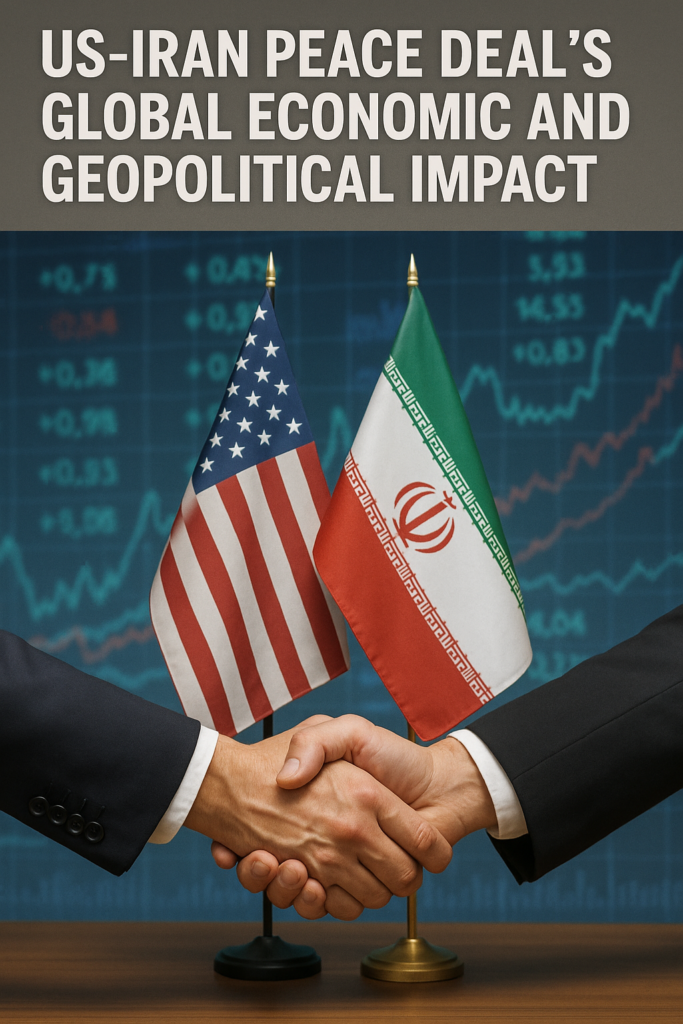
A US-Iran peace deal would trigger an immediate realignment of global energy markets and rewrite the geopolitical architecture of the Middle East. The removal of secondary sanctions on Tehran would normalize trade, release frozen assets, and re-integrate Iran into the global financial system.
The economic and strategic consequences of this diplomatic breakthrough would be felt across four critical areas:
The Energy Market Shockwave
The most immediate disruption would hit the global oil and gas sectors.
- Massive Supply Influx”: Iran holds the world’s third-largest proven oil reserves. Lifting sanctions would return an estimated 1.5 million to 2 million barrels per day (bpd) of crude to the legal market, driving down global Brent prices.
- OPEC+ Cohesion Tested: The return of Iranian barrels would threaten OPEC+ production quotas. Saudi Arabia and Russia would face a difficult choice: cut their own output to defend prices or launch a market-share war.
- Alternative Gas for Europe: Over the medium term, European markets could tap into Iran’s South Pars field—the world’s largest natural gas field—permanently reducing Europe’s reliance on Russian LNG.
Stabilization of Global Maritime Chokepoints
The deal would neutralize the primary security threats to global shipping lanes.
- Strait of Hormuz Security:This narrow corridor handles over 20% of the world’s petroleum liquids. A bilateral peace agreement removes the persistent threat of Iranian tanker seizures and naval skirmishes.
- Red Sea Stabilization: Normalization would dry up state sponsorship for Houthi rebel attacks in the Bab al-Mandab strait, restoring the Suez Canal as a viable, low-risk shipping route and slashing global maritime insurance premiums.
Geopolitical Realignment and the Axis of Resistance
The diplomatic map of the Middle East would be fundamentally redrawn, altering alliance dynamics.
- De-escalation of Proxy Networks: Financial and military pipelines from Tehran to Hezbollah in Lebanon, militias in Iraq, and the Assad regime in Syria would degrade, lowering regional conflict risks.
- Friction with Traditional Allies: US relations with Israel and Saudi Arabia would face severe strain. Jerusalem would view any Western accommodation of Tehran as an existential threat, potentially accelerating unilateral covert operations.
- The Isolation of Russia: Russia would lose its primary military supplier of drones and ballistic missiles. Furthermore, a sanctions-free Iran would compete directly with Russia for energy market share in Asia.
Unlocking a Major Frontier Market
With a highly educated population of 85 million and a strategic position bridging Europe, Central Asia, and the Middle East, Iran represents a massive untapped market.
- Foreign Direct Investment: European and Asian multinationals—particularly in automotive, aviation, infrastructure, and technology—would move rapidly to secure first-mover advantages.
- Financial Re-integration: Reconnecting Iran to the SWIFT banking network would disrupt illicit finance channels and slow Tehran’s drift toward alternative, non-dollarized financial systems led by China and Russia.

