
The Strategic Redundancy Mandate
The Eastern Cape is undergoing a fundamental structural transition from an industrial manufacturing hub to a critical nexus in the global digital supply chain. While Cape Town and Durban have historically dominated South Africa’s connectivity landscape, the Eastern Cape—specifically the Nelson Mandela Bay and Buffalo City metros—is positioning itself as a high-capacity alternative that offers what established hubs currently lack: geographic redundancy and massive energy scalability.
Subsea Integration and Latency Optimization
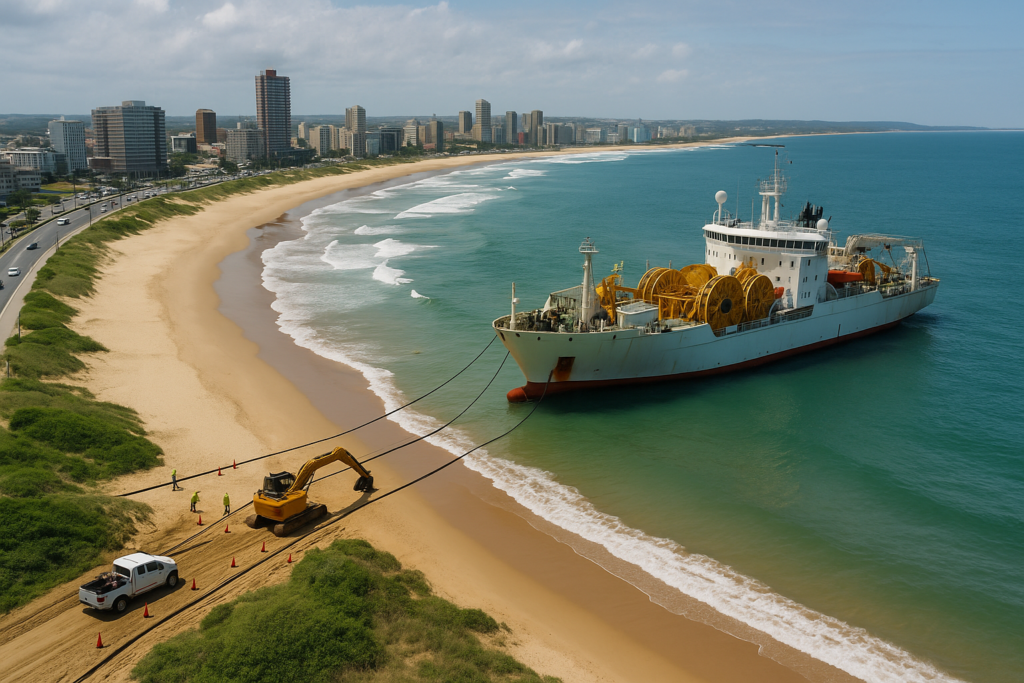
The region’s ascent is driven by its selection as a landing point for next-generation subsea cable systems. By integrating into the 2Africa and Equiano ecosystems, the Eastern Cape provides a direct, high-speed gateway to European and Asian markets. This infrastructure does not merely add capacity; it significantly reduces latency for inland data centers and provides a vital fail-safe for the national grid, ensuring that South Africa’s internet economy remains resilient against localized outages or cable breaks.
- Geographic De-risking: Provides a third major international landing zone, mitigating the risk of total connectivity loss from localized disruptions in traditional hubs.
- Hyperscale Scalability: Significant coastal land availability allows for the construction of large-scale data centers that are increasingly constrained by space and power in land-scarce Cape Town.
- Backhaul Efficiency: Aggressive investment in regional fiber backbones is connecting industrial zones directly to global subsea transit points, bypassing traditional domestic bottlenecks.
The Renewable Energy Synergy
Data centers are power-intensive assets with demanding sustainability requirements. The Eastern Cape’s established wind and solar corridors provide a unique competitive advantage for ESG-conscious technology firms. The ability to colocate high-density computing infrastructure near primary sources of renewable generation simplifies the path to “net-zero” operations. This proximity reduces transmission losses and allows for more aggressive Power Usage Effectiveness (PUE) targets, making the province a preferred destination for hyperscale investors looking to decouple growth from carbon-heavy power grids.
Economic Repositioning Beyond Automotive
For decades, the provincial economy was synonymous with the automotive sector. The shift toward digital-first infrastructure allows for a total diversification of the local labor market and economic output. High-tech infrastructure attracts a secondary ecosystem of managed service providers, cybersecurity firms, and cloud architects. This transition is not replacing the manufacturing sector but rather augmenting it with the digital capabilities required for smart manufacturing, automated logistics, and Industry 4.0 integration.
Key Indicators of Tier-One Status
- Direct International Transit: Elimination of backhaul dependency on Johannesburg for international traffic, lowering operational costs for regional ISPs.
- Inbound Capital Expenditure: Significant CAPEX from private equity and global tech consortiums into regional landing stations and carrier-neutral facilities.
- Infrastructure Resilience: The integration of localized micro-grids and independent power producers (IPPs) ensures high availability for mission-critical digital assets.
The Eastern Cape is no longer a peripheral player. Through a combination of strategic geography, subsea access, and renewable energy capacity, it has secured its position as a tier-one gateway in the global digital economy.

