
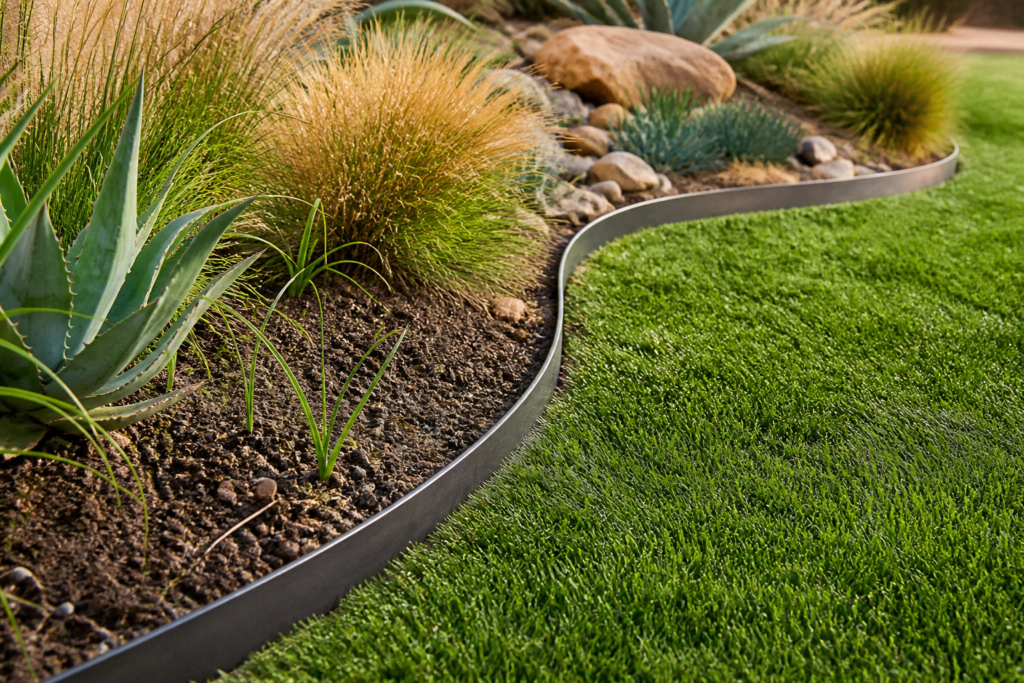
Homeowners across Gauteng are increasingly abandoning traditional plastic and timber garden borders in favor of more robust materials, as Johannesburg’s unique climate continues to challenge standard landscaping practices. With extreme UV radiation in the summer and significant soil expansion and contraction during the winter frost cycles, the demand for professional garden edging in Johannesburg has shifted from purely aesthetic choices to engineering-led durability. Industry experts suggest that the “Highveld factor”—a combination of intense direct sunlight and erratic rainfall—can degrade inferior materials in as little as eighteen months.
The Highveld Challenge: Why Material Choice Matters
Johannesburg sits at an elevation of roughly 1,750 meters, meaning the UV index is significantly higher than in coastal regions. For gardeners, this means that standard PVC or thin-gauge plastic edging, often marketed as “budget-friendly,” becomes brittle and cracks within two seasons. Furthermore, the region’s predominantly clay-based soils undergo dramatic volume changes between the torrential summer afternoon thundershowers and the bone-dry winter months.
According to specialists at Garden Cobble Edging, a firm specializing in durable landscaping solutions, the physical pressure exerted by shifting soil is the leading cause of “edging heave.” When the soil expands, it pushes against the border; if the material lacks the weight or the structural integrity to withstand this pressure, the line of the garden bed becomes distorted, requiring costly repairs or total replacement.
Comparing Material Longevity in the Gauteng Context
To assist property owners in making informed decisions, recent industry reports have categorized common edging materials based on their performance in Johannesburg’s specific environmental conditions:
- Concrete Cobbles: Highly recommended. Their weight and density provide a natural barrier against soil movement, and they are impervious to UV degradation.
- Natural Stone: Excellent durability but requires professional installation to prevent weed ingress between gaps.
- Treated Timber: Moderately durable but prone to rot during the heavy summer rain season and termite infestations common in South African suburbs.
- Plastic/Composite: Generally discouraged for permanent installations due to thermal expansion and fading.
The Rise of the Concrete Cobble
In the professional sector, pre-cast concrete cobbles have emerged as the gold standard for longevity. Unlike poured concrete, which can crack if the ground shifts, individual cobbles allow for microscopic movements without compromising the entire structure. This flexibility is vital in areas like Sandton and northern Johannesburg, where “heaving” soil is a common geological trait.
Beyond structural integrity, cobbles provide a clean, defined aesthetic that maintains property value. A well-installed cobble border acts as a permanent “mowing strip,” preventing lawn mowers from damaging delicate plants and ensuring that grass runners do not invade flower beds—a perennial struggle for South African gardeners during the peak growing season.
Installation Integrity: The Professional Edge
Even the highest quality materials can fail if the installation does not account for local conditions. Investigative surveys into failed landscaping projects often reveal a lack of proper trenching or the absence of a stable base. Professionals emphasize that edging is not merely “placed” on the soil but integrated into it.
The team at Garden Cobble Edging notes that successful projects typically involve a calculated depth of trenching and, in many cases, a stabilized mortar bed to ensure the cobbles remain level over several decades. For those seeking expert garden maintenance advice, the consensus is clear: investing in high-mass, UV-stable materials at the outset is significantly more cost-effective than the cycle of replacing degraded plastics every few years.
Future-Proofing Your Garden
As water-wise gardening (xeriscaping) becomes more prevalent in South Africa, the role of edging has evolved. It is no longer just a decorative border but a critical tool for water management. Durable edging helps retain mulch and moisture within garden beds, preventing runoff during the heavy Highveld storms. By selecting materials that can withstand the test of time and climate, Johannesburg residents are not just beautifying their homes; they are building resilient outdoor spaces that can endure the rigors of the South African environment.

