
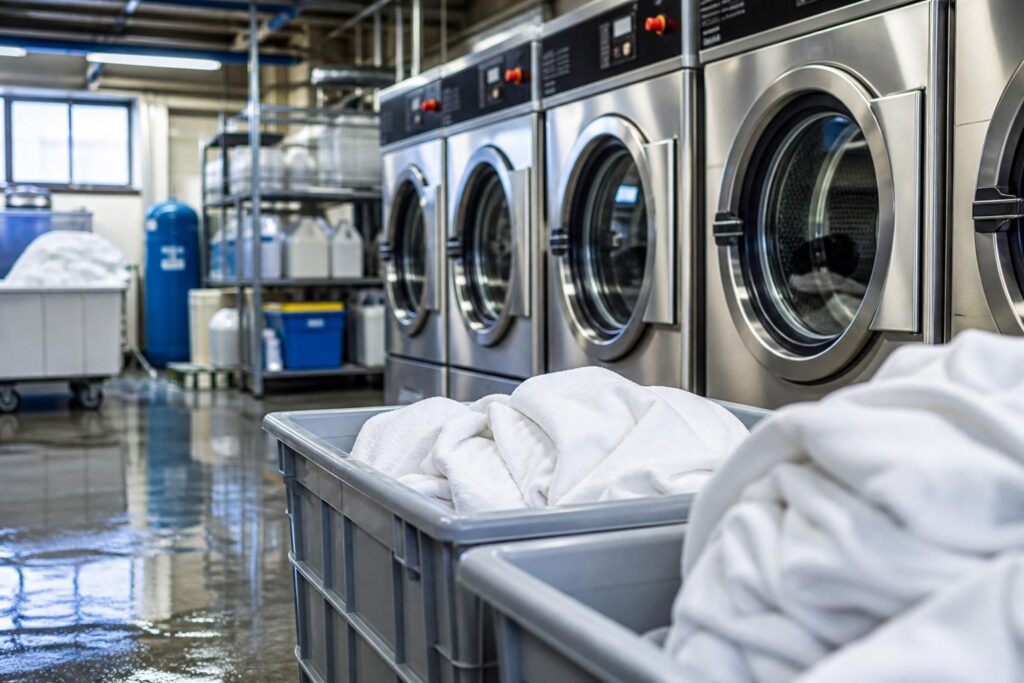
Midrand, South Africa — Commercial laundry operators in Midrand are increasingly adopting tighter water-use controls and detergent-management standards as businesses across Gauteng face mounting pressure to reduce operating costs, improve compliance and limit environmental impact. The shift is being driven by rising utility costs, greater scrutiny of wastewater discharge, and growing demand from hospitality, healthcare, food service and corporate clients for more accountable cleaning processes.
According to Laundry Studio, the move is not only about sustainability messaging. It is becoming a practical response to business conditions in which water efficiency, chemical dosing and linen care standards directly affect margins and service quality. For companies sourcing professional laundry services in Midrand, the emphasis is increasingly on measurable performance rather than price alone.
Water management moves from background issue to operational priority
Midrand’s commercial sector sits within one of Gauteng’s busiest business corridors, serving offices, logistics operators, healthcare facilities, hotels and event venues. These customers typically require frequent linen turnaround and high-volume washing, making water consumption a material cost factor. In a province where water security remains a recurring concern, laundering practices that reduce litres per kilogram of linen are gaining relevance across procurement decisions.
Industry operators are responding by installing systems that monitor water levels per wash cycle, reusing rinse water where appropriate, and matching wash programmes to fabric type and soil load. The aim is to reduce wastage without compromising hygiene standards. For businesses handling uniforms, towels, bedding and clinical textiles, that balance is essential.
Laundry Studio says the trend is also shaped by broader corporate sustainability targets. “Clients are asking more detailed questions about how laundry is processed, how much water is used and what happens to wastewater,” the company notes. “Commercial laundry businesses that can demonstrate consistent water and detergent controls are better positioned to support those reporting requirements.”
Detergent standards are becoming part of procurement criteria
Alongside water efficiency, detergent management has become a focal point for commercial laundries in Midrand. Excess detergent can increase rinse demand, add to operating costs and place additional strain on drainage systems. Under-dosing, meanwhile, risks hygiene failures and faster textile wear. Operators are therefore moving toward measured dosing systems and formulations aligned to specific textile and soil conditions.
This shift matters in South Africa, where businesses are under pressure to protect both utility budgets and asset replacement cycles. Linen and uniform longevity is a hidden cost centre for many organisations, especially in hospitality and healthcare. A laundry process that preserves fabric integrity while meeting cleanliness standards can materially extend replacement intervals.
For clients comparing providers, detergent control has become a proxy for quality management. Rather than treating laundry as a basic back-office service, procurement teams are increasingly reviewing whether suppliers can document chemical use, wash validation and stain-removal performance.
Local demand is being shaped by sector-specific compliance needs
Midrand’s commercial laundry market serves a wide range of sectors, each with different compliance expectations. Healthcare providers require sanitary processing and separation controls. Food service businesses need consistent treatment of table linen and uniforms. Corporate clients often prioritise presentation, turnaround times and predictable volume handling. Hotels and guesthouses, meanwhile, are under pressure to manage occupancy swings while keeping operating costs in check.
These demands are encouraging more structured laundry partnerships. Businesses are looking for suppliers that can handle high throughput, reduce rewash rates and align with internal sustainability policies. In practice, that means commercial laundries are expected to provide more than collection and delivery. They are expected to support operational continuity.
Laundry Studio says the conversation with clients has become more technical. Buyers are asking how loads are sorted, which detergents are used for different fabrics, and what safeguards are in place to avoid overprocessing. That level of scrutiny reflects a maturing market in which laundry is increasingly treated as a managed service rather than a commodity.
Why sustainability is also a cost-control strategy
Although sustainability is often framed as an environmental objective, commercial laundry businesses in Midrand are finding that it also functions as a cost-control strategy. Water-efficient equipment reduces utility exposure. Controlled chemical dosing limits waste. Better wash programming lowers the risk of fabric damage and returns. Together, those measures help operators absorb inflationary pressure more effectively.
For South African businesses dealing with electricity constraints, water stress and tighter procurement budgets, this multi-factor approach has become especially important. The companies most likely to benefit are those that can document consistent operating standards and show a direct link between process discipline and service outcomes.
That is why commercial laundry providers are investing in systems and processes that can withstand customer audits and internal review. In many cases, the differentiator is no longer simply capacity. It is governance.
What procurement teams are now looking for
- Measured water use per wash cycle
- Controlled detergent dosing and fabric-specific wash programmes
- Evidence of wastewater and hygiene compliance
- Reduced rewash rates and improved textile longevity
- Reliable turnaround times for business-critical linen
A shifting market for commercial laundry in Gauteng
As businesses in Midrand and the wider Gauteng region reassess suppliers, commercial laundry providers that can demonstrate sustainability discipline are likely to gain an advantage. The market is moving toward more transparent, data-informed service delivery, with buyers increasingly willing to ask how outcomes are achieved rather than simply whether loads are collected and returned.
For Laundry Studio, the current shift signals a broader change in how the sector is evaluated. Water stewardship, detergent control and operational consistency are no longer peripheral issues. They are now central to commercial performance, customer trust and long-term resilience.
In a region where water scarcity, rising input costs and service reliability remain persistent business concerns, that evolution is likely to continue shaping procurement decisions across Midrand’s commercial laundry segment.

