
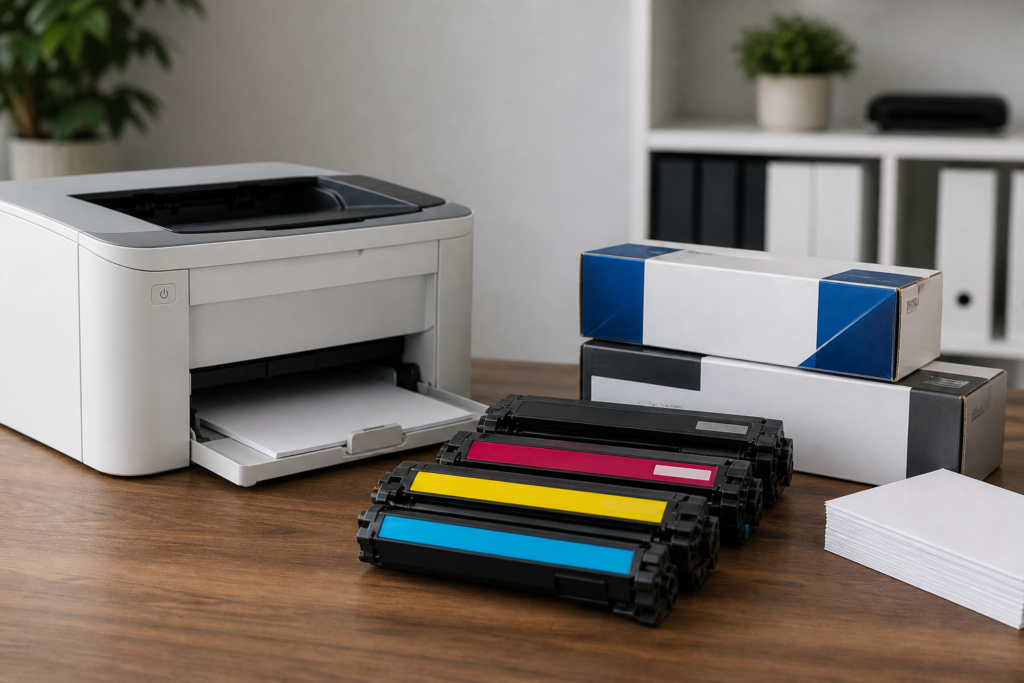
Johannesburg’s commercial hubs, from the high-rises of Sandton to the industrial zones of City Deep, are currently facing a sophisticated influx of counterfeit and “grey market” printing consumables. While the temptation to slash overheads remains high for Gauteng businesses grappling with rising operational costs, the hidden price of non-genuine ink and toner is beginning to surface in the form of catastrophic hardware failure and voided manufacturer warranties.
According to industry data, the trade in counterfeit cartridges costs the global imaging industry billions annually, but the local impact is felt most acutely by small-to-medium enterprises (SMEs) in South Africa. These businesses often unknowingly purchase “clones” that look nearly identical to original equipment manufacturer (OEM) products but lack the precision engineering required for modern high-speed laser and inkjet systems.
The Hidden Risks of the “Cheap” Alternative
In the competitive landscape of Johannesburg’s business sector, procurement officers are often tasked with finding the lowest price point. However, the technical specialists at Anza Technology warn that the initial savings of 40% to 60% are frequently offset by the long-term damage these products cause. Non-genuine cartridges are prone to leaking, which can contaminate the internal components of a printer, leading to expensive repairs or the total replacement of the machine.
Furthermore, counterfeit ink often lacks the chemical stability of original formulas. This results in poor print quality, clogged print heads, and significantly lower page yields than advertised. For a Johannesburg law firm or accounting practice where document clarity is non-negotiable, a streaked or faded printout is more than a nuisance—it is a professional liability.
Anza Technology’s Guide to Spotting a Fake
Identifying a counterfeit product has become increasingly difficult as packaging technology evolves. However, there are several red flags that Johannesburg buyers should look for when sourcing authentic printing consumables in South Africa. Industry experts suggest a three-tier verification process:
- The Security Seal Test: Most major brands like HP, Canon, and Brother use holographic security labels. When tilted, the colours or patterns should shift. If the seal is static, blurry, or missing, the product is likely a fake.
- The QR Code Verification: Modern OEM packaging includes a unique QR code. Using a smartphone, buyers can instantly verify the serial number against the manufacturer’s global database.
- Physical Consistency: Genuine cartridges are manufactured to exacting standards. Rough plastic edges, visible glue marks, or cartridges that do not “click” easily into place are signs of a refurbished or cloned shell.
The Impact on Warranties and Sustainability
One of the most significant risks for Johannesburg businesses is the legal fine print regarding warranties. Most major printer manufacturers explicitly state that damage caused by non-original supplies is not covered. This means a single R500 counterfeit cartridge could potentially “brick” a R50,000 office multi-function printer with no recourse for the owner.
Beyond the financial risk, there is an environmental toll. Authentic manufacturers invest heavily in “closed-loop” recycling programs. In contrast, counterfeiters rarely offer take-back schemes, leading to thousands of plastic shells ending up in Gauteng landfills. By choosing verified Johannesburg printer supply experts, companies contribute to a more sustainable local economy while ensuring their hardware remains protected.
Navigating the Local Supply Chain
The rise of online marketplaces has made it easier for unscrupulous sellers to hide behind professional-looking storefronts. To combat this, procurement teams should prioritize suppliers who maintain direct relationships with distributors and offer transparent return policies. A reputable supplier will always be able to provide documentation regarding the origin of their stock and offer technical support if a cartridge fails to perform as expected.
As Johannesburg continues to serve as the economic engine of Southern Africa, the demand for reliable office technology only grows. While the pressure to reduce costs is understandable, the consensus among industry leaders is clear: the integrity of your printed word—and the machines that produce it—depends entirely on the authenticity of what you put inside them. Investing in genuine supplies is not just a maintenance choice; it is a risk management strategy for the modern South African business.

