
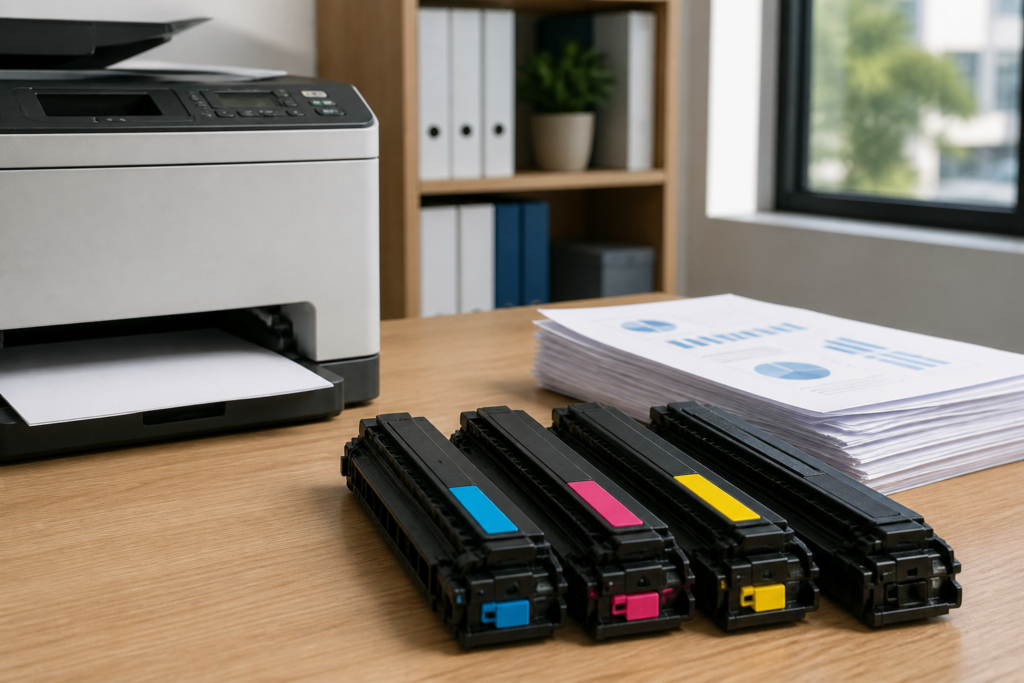
In a tightening South African economy where operational efficiency has become a prerequisite for survival, businesses are scrutinizing every line item on their balance sheets. While electricity and logistics often dominate the conversation, one of the most persistent “leaking taps” in corporate expenditure is the cost of printing. Industry data suggests that many South African SMEs are overspending by as much as 30% on office overheads simply due to inefficient procurement of printer cartridges and poorly matched hardware.
The challenge lies in the complexity of the market. With a fluctuating Rand affecting the price of imported components and a sea of generic alternatives flooding the local market, selecting the right printing strategy is no longer a clerical task—it is a financial imperative. Industry specialists at Anza Technology note that the “cheapest” cartridge on the shelf often results in the highest cost per page when factoring in failure rates and lower-than-advertised yields.
Understanding the ‘Price vs. Value’ Equation
The primary metric for any business looking to minimize costs is the Cost Per Page (CPP). This is calculated by dividing the price of the cartridge by its expected page yield. However, the South African market often falls into the trap of looking only at the upfront price tag. High-capacity or “XL” cartridges frequently offer a significantly lower CPP, despite a higher initial cost, because they contain a larger volume of ink or toner relative to their packaging and internal components.
To navigate this, procurement officers must look beyond the box. A critical step is identifying whether a printer’s duty cycle matches the office output. Using a home-office inkjet for high-volume corporate documents results in rapid consumable depletion and higher maintenance costs. For those managing high-volume environments, sourcing printing consumables in South Africa from suppliers who offer transparent yield data is essential for accurate budgeting.
The Genuine vs. Compatible Conundrum
The debate between Original Equipment Manufacturer (OEM) cartridges and third-party compatibles is particularly fierce in the local market. While third-party options can offer immediate savings, the risks include inconsistent print quality and potential damage to the printer’s drum or fuser units. This is where the expertise of a dedicated technology partner becomes invaluable.
Modern “New Build” compatibles have improved significantly, but they must be vetted for reliability. Expert providers, such as the team at Anza Technology, emphasize that the goal is not just to find a cheaper cartridge, but to find a reliable one that maintains the integrity of the enterprise-grade printing hardware. In many cases, using high-quality remanufactured cartridges can reduce environmental impact—a growing concern for South African firms aiming for ESG (Environmental, Social, and Governance) compliance.
Strategies for Long-Term Cost Reduction
To truly minimize printing costs, South African businesses should implement a multi-layered approach:
- Standardize Hardware: Running a fleet of ten different printer models means stocking ten different types of cartridges. By standardizing on a single brand or series, businesses can leverage bulk-buying power and simplify inventory management.
- Draft Mode and Duplexing: It sounds elementary, but enforcing “draft mode” for internal documents can extend the life of a toner cartridge by up to 15%. Similarly, default double-sided printing slashes paper costs, which have risen sharply over the last 24 months.
- Monitor Usage Patterns: Implementing print management software allows managers to see who is printing what. Often, a significant portion of print costs comes from unnecessary full-color printing of emails or internal memos.
The Impact of Load Shedding on Print Efficiency
An uniquely South African factor is the impact of power instability on printing equipment. Frequent power surges and improper shutdowns during load shedding can cause “head cleaning” cycles in inkjet printers, which consumes a significant amount of ink without ever putting a drop on paper. Laser printers, which require heat to fuse toner, are also sensitive to power fluctuations. Investing in surge protection and ensuring printers are properly shut down before scheduled outages can prevent the wasted consumable costs associated with forced re-calibration cycles.
The Verdict: Data-Driven Procurement
Minimizing print costs in the current South African climate requires a shift from reactive buying to proactive management. By focusing on page yields rather than shelf prices, and by partnering with reputable suppliers who understand the local landscape, businesses can transform their printing from a runaway expense into a streamlined operational utility. As the digital transformation continues, the goal is not necessarily to stop printing entirely, but to ensure that every page produced is done so at the lowest possible cost to the bottom line.

